Help
A refrigerator that has stopped cooling: what to check first
Start by working out which compartment is actually warm, because a fridge that is warm while the freezer is fine, a freezer that is warm while the fridge is fine, and both warm together are three different faults with almost nothing in common.
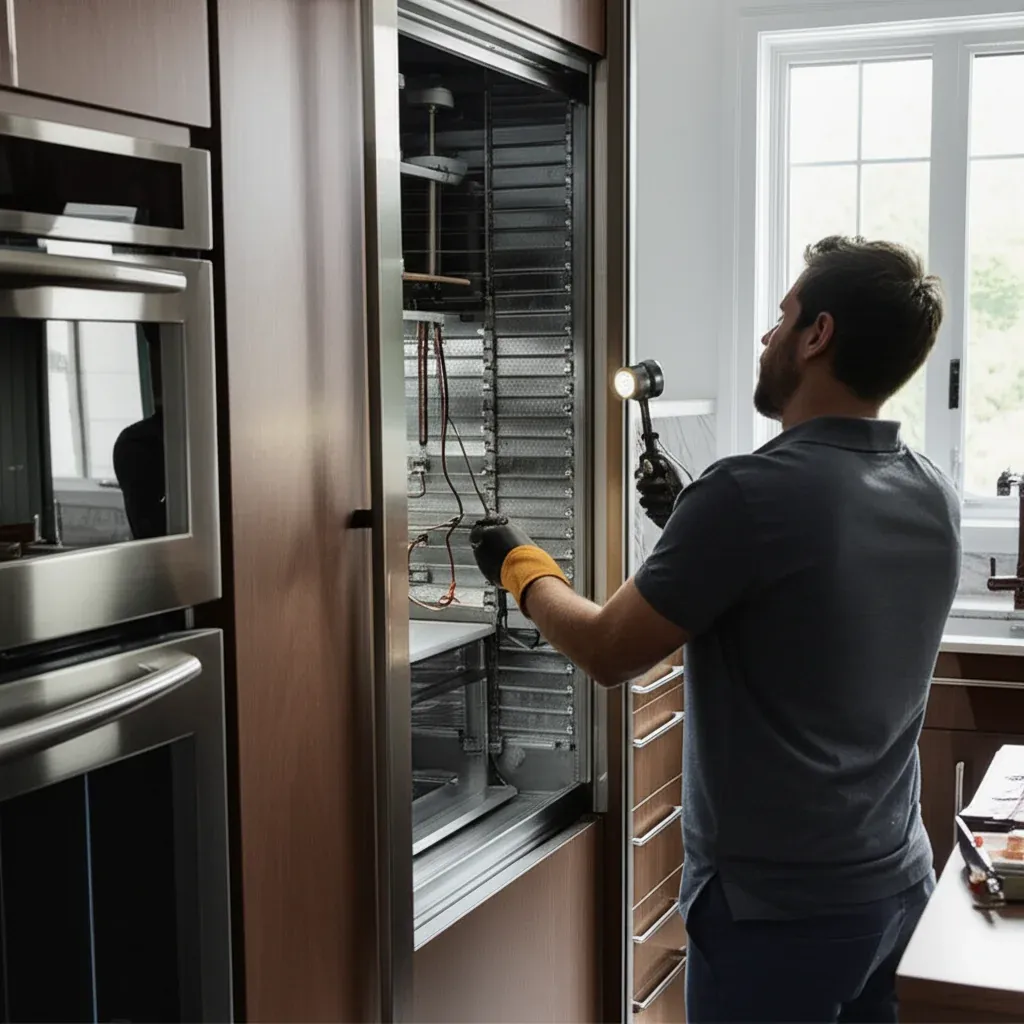
01
Which half is warm?
If the freezer is holding and the refrigerator is not, cold is being made and not delivered. On most built-ins the refrigerator compartment is fed by air moved from the evaporator, so a stalled circulation fan, a blocked air path or a damper that has stopped opening will do it. This is the most common version of the complaint and it is rarely the compressor.
If both compartments are warm and the unit is silent, look for power and for a control that has been switched off — service or showroom modes exist on this equipment and they get triggered by accident. If both are warm and you can hear the compressor running, that points at the sealed system or at a defrost failure that has iced the evaporator solid.
If the freezer alone is warm, defrost is the first suspect: heater, sensor or control. The refrigerator side may go on looking fine for days while that develops.
02
Five checks that are safe to make
- Confirm the door is closing fully. Push it shut from a hand-width open and watch whether it pulls itself in on the last inch. A jar of something on a door shelf holding it fractionally open will warm a compartment overnight.
- Look at the base grille. If it is furred with dust, or blocked by a mat, a toe board or something stored against it, the condenser has nowhere to put its heat.
- Listen. A running compressor with a warm cabinet is a very different diagnosis from a silent one, and it is worth knowing which you have before you call.
- Give it a day if the cause is obvious. A big restock, a door left open, or a power cut can each take twenty-four hours to recover from without anything being wrong.
- If you can reach the rear panel inside the freezer, note whether it is heavily iced. A thick slab of frost there is the defrost circuit telling you what has failed.
03
What to leave alone
- Do not pull a built-in out of its opening. It is scribed to the cabinets and standing on a finished floor, and it does not need to move for the common faults.
- Do not chip or melt ice off an evaporator. The tubing is thin aluminium and a puncture turns a defrost repair into a sealed-system one.
- Do not add refrigerant, or let anyone suggest a top-up over the phone. A sealed system does not consume refrigerant; if it is low, it has a leak, and the leak is the repair.
- Do not run the unit for weeks on a compressor that is short-cycling. Clicking on and off every few minutes wears out the one component nobody wants to replace.
04
When it is time to call
Call when the doors and the grille are clear and it still will not hold; when the evaporator ices up again within a fortnight of being defrosted; when the compressor is short-cycling; or when an alarm keeps returning after being cleared.
Have the model and serial ready from the plate behind the upper grille or inside the compartment, along with what each compartment is reading against what it is set to. A flat $95 covers the visit and the full diagnosis, and it comes off the bill when you approve the repair.
Booking
Describe the fault. Get the figure before anything opens.
A flat $95 covers the visit and the diagnosis, and comes off the bill when you approve the repair. Visits run 8:00 am – 8:00 pm, seven days; the line is answered 24/7.