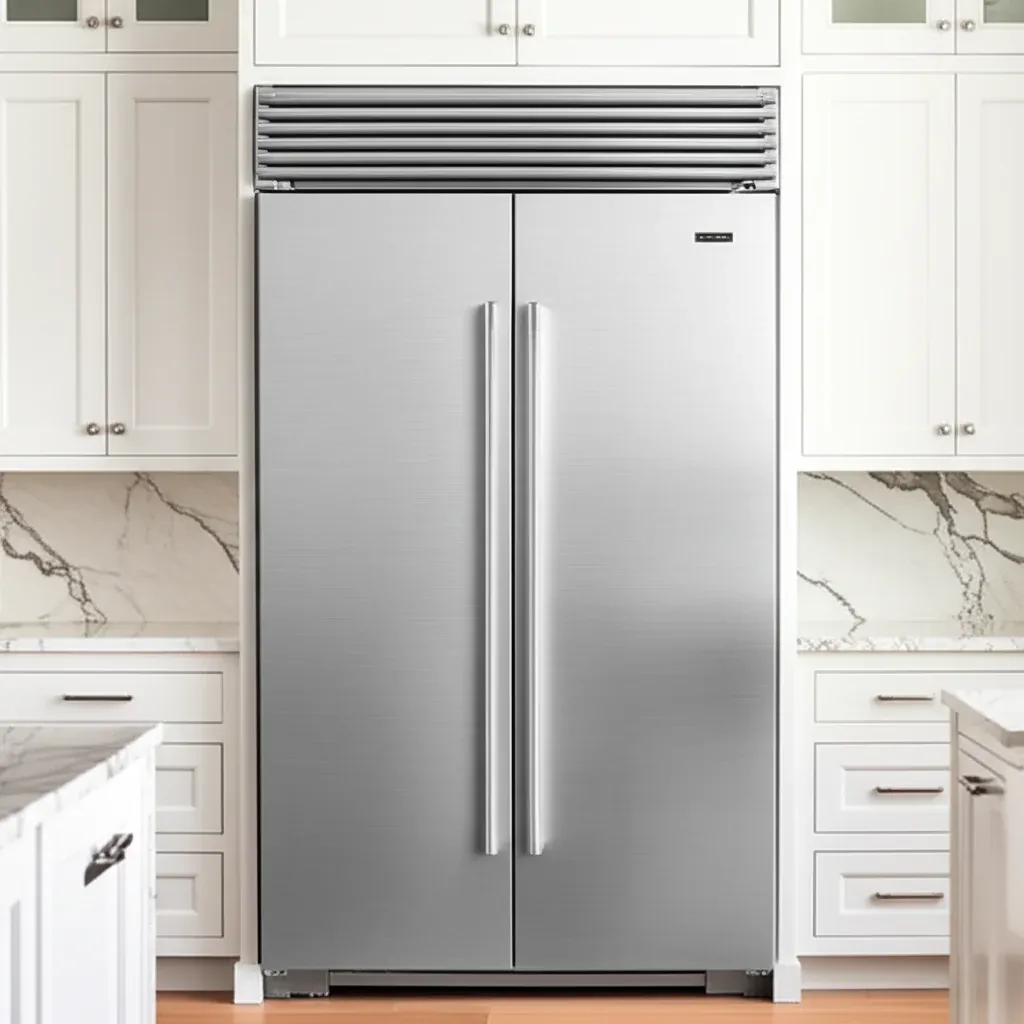
Sub-Zero Refrigerator Repair
Sub-Zero Fridge and Freezer Not Cooling: What to Check, in Order
When a fridge and freezer both stop cooling, check power and set points, clear the vents, vacuum the condenser and test the door seals first. If it is still warm a day later, a fan, the defrost system or the sealed system is the likely cause.
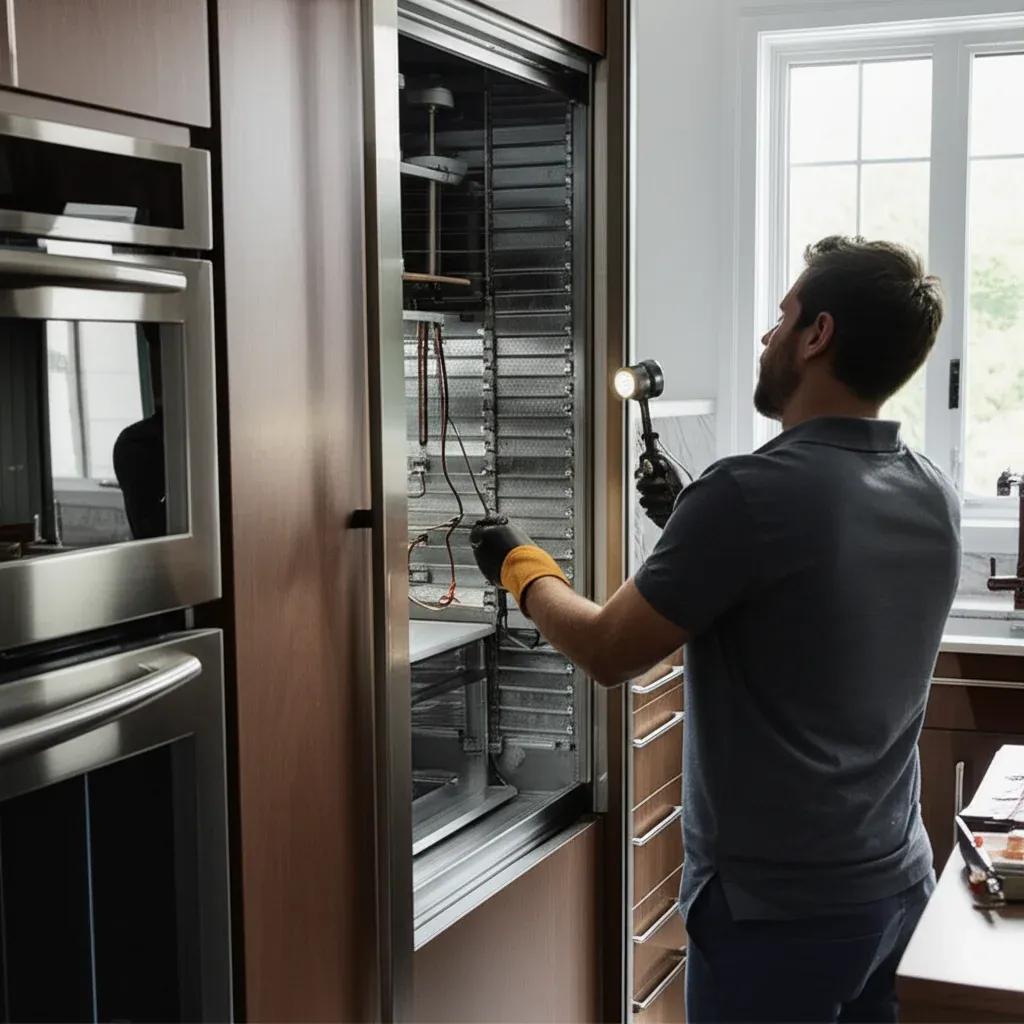
If the fridge and the freezer are both warming at once, start with whatever affects the whole appliance: confirm it has power and the set points have not moved, clear the vents and give it a day, then vacuum the condenser and test the door seals. If those checks change nothing within about 24 hours, the remaining suspects are a fan motor, a defrost part or the sealed system, and no further home check will tell them apart, so book a diagnosis at that point. A healthy Sub-Zero reads close to 38°F for fresh food and 0°F for frozen, so an inexpensive appliance thermometer in each compartment tells you more than the display does.
The order matters more on a built-in. A panel-ready Sub-Zero set into millwork cannot be rolled out and replaced over a weekend, so the free checks deserve care before anyone pulls the unit from its opening. Many Sub-Zero models also cool the two compartments with separate evaporators, which changes how you should read the symptoms below.
First, read the symptom correctly
Two different complaints hide under the same search. When both compartments warm together, look at the parts both sides share: power, the control, the condenser, the condenser fan and the compressor. A freezer that stays cold while the fridge creeps upward points somewhere else. On a conventional single-evaporator refrigerator, the fresh-food side is fed by air blown up from the freezer, so a frosted coil or a stalled evaporator fan starves the fridge while the freezer still feels fine. On a Sub-Zero with dual refrigeration, the fresh-food side has its own coil and fan, so a warm fridge beside a cold freezer usually means a fault on that side alone.
Before touching anything, jot down both temperatures, whether the compressor is running, whether you can hear fans, and whether frost is building on the back wall of the freezer. A warm cabinet with the compressor humming away is a different diagnosis from a warm cabinet in silence, and knowing which you have makes any later visit quicker.
The simple causes you can check safely
Power and settings. Look at the display. A tripped breaker, a control switched off for cleaning, or a set point nudged by a child or a housekeeper happens more often than people expect. Sub-Zero’s guidance is that a new setting needs 24 hours to take hold, so judge a change the next day, not the next hour. The display can also be telling you something specific, which the next section decodes.
Airflow inside. Crammed shelves, a tray pushed against the rear vents or a bag of ice blocking the freezer’s air path can leave one side warm. Clear a hand’s width around the vents. A big grocery restock or a door left ajar overnight can need a full day to recover, so wait 24 hours before deciding anything has failed.
Condenser dust. The condenser sheds the heat the system pulls out of your food. A Classic (CL) keeps it under the grille that flips up along the top; a Designer (DET, DEC) keeps it at floor level, behind a kickplate fastened with two screws. Matted with dust, it makes the compressor run long and still lose ground, and both compartments warm together. Switch off at the control panel, put gloves on, and run a soft vacuum brush along the fins rather than across them; Sub-Zero says chemical cleaners are not needed. It recommends doing this every six to twelve months, more often with pets, and says a unit under six months old does not need it. Our spring cleaning notes for built-ins walk through the job. One limit worth knowing: if the refrigerator reads above 48°F with the control at 38°F, Sub-Zero does not expect a cleaning alone to bring it back, so at that point book rather than wait.
Door seals. Start with the closing itself: push the door shut from a hand’s width open and watch whether it draws itself in over the last inch. A tall jar on a door shelf can hold a door fractionally open all night. Then close the door on a strip of paper and tug it out, repeating at the top, the bottom and both sides. Paper that pulls free without resistance marks a spot where the gasket has lost contact. Frost collecting near the door edge, or sweat on the cabinet face in humid weather, tells the same story. Replacing a torn or flattened gasket on a built-in typically costs $300–$730, and the new seal has to be seated properly against the door.
What a Sub-Zero display is telling you
Sub-Zero documents its own messages, and several of the commonest ones are owner-safe to act on:
- EC50 with Service flashing: the refrigerator compressor has been running too long. With the temperatures still close to normal, clean the condenser, then clear the code by keeping the bell key — the door-ajar alarm — pressed for 15 seconds. With the compartment already warm, book the visit.
- EC40 with Service flashing (600, 648PRO and 700 Series): the same complaint on the freezer side. Under 10 degrees above the setting, clean the condenser; more than 10 above with the door shut, book service, and do not keep clearing the code while the temperature climbs.
- “Vacuum Condenser” flashing: the unit is working too hard or running warm — a dusty condenser, a seal letting air in, or a problem inside the unit itself. Cleaning the condenser and switching the unit off and on again resets the message.
- Sh r on a Legacy Classic (BI): Showroom Mode, in which the unit lights up and does not cool. Switch it off with Power; then, with one Warmer key and one Colder key held down together, press Power once more and let go of everything. On a current Classic or Designer, a display reading 38° and 0° while nothing gets cold may be the same mode, and Sub-Zero says to call its customer care line.
- Double dashes (—) on a Classic (BI), 600 or 700 Series: that zone is turned off. Switch the unit off at Power, then keep the zone’s Warmer key held down as you press Power again.
- Interior lights out on a Classic (CL) or Designer (DET, DEC): a door or drawer may have been left ajar, which switches the lights off to cut heat. Close everything for an hour before calling.
If none of those applies, the display reads normally and the cabinet is still warm a day later, the cause is mechanical, and that is the next section.
The serious causes, and how they show
A fan that has stopped. With the grille off and the unit running, you should hear the condenser fan moving air. Silence there, or a fan that turns slowly and hums, lets the condenser overheat. Inside the freezer, an evaporator fan that squeals, or stays silent with the door switch held in, leaves cold air sitting on the coil. A fan motor replacement typically runs $300–$620.
Defrost trouble. A solid sheet of frost on the freezer’s back panel means the defrost heater, its thermostat or a sensor has stopped clearing the coil. Airflow drops, and the fresh-food side is usually first to notice. A manual defrost buys time and proves the point: empty the unit, switch it off with the doors open, lay towels down, and leave it for a full day. If it cools again and then slides back within a few days, the defrost part is the culprit, and that repair typically costs $280–$670. Never chip at the ice with a knife or scraper; a punctured evaporator turns a modest repair into a sealed-system one.
The control board. Erratic temperatures, a display that resets itself, or fans and compressor that ignore the set point can trace back to the electronic control. A board usually costs $520–$860, and the sensors should be tested first, because a failed sensor can make a healthy board look guilty.
The sealed system. If the compressor runs constantly, the condenser fan works, the coil is free of frost and nothing gets cold, the cause may be lost refrigerant, a restriction or a compressor that has stopped pumping. These repairs typically run $940–$2,150. Set against a comparable new built-in at $8,660–$19,630 for the appliance alone, a sealed-system fault in an otherwise sound cabinet is often worth fixing.
Where to stop
Stop once you have checked power and settings, read the display, cleared the vents, cleaned the condenser, tested the seals and, if frost was the clue, run a manual defrost. Past that point the work involves live electrical parts, sealed refrigerant lines and possibly removing the unit from its cabinetry, and none of that is a homeowner task. Do not try to pull a built-in out yourself; it is heavy, top-weighted and anchored to the surrounding cabinets. Current Sub-Zero guides also warn that the refrigerant is flammable and that only technicians trained for it may work on the system.
Two more things to leave alone. Do not let anyone talk you into a refrigerant top-up over the phone: a sealed system does not use refrigerant up, so a low charge means a leak, and the leak is the repair. And do not leave a compressor clicking on and off every few minutes for weeks while you wait to see; short-cycling wears out the one part nobody wants to replace.
While you wait, look after the food. Perishables that have sat above 40°F for more than two hours belong in the bin, and a full freezer kept closed will usually stay frozen for about two days, roughly half that when half full. A cooler packed with ice buys useful time.
Booking a diagnosis
Sub-Zero Repair Westwood works independently of the manufacturer and installs factory-approved parts. A visit costs a flat $95, which covers the technician coming out and pinning down the fault; approve the repair and that sum is deducted from it. Every figure above is a typical band; the firm quote follows the diagnosis. Call (508) 401-8451. We look after homes in Westwood and in Newton, Needham, Needham Heights and Needham Center. If the unit is less than five years past installation, read our note on what the Sub-Zero warranty covers before you book anyone, us included. If only the freezer is struggling, our Sub-Zero freezer repair page explains how we trace it, and the refrigerator repair page covers the fresh-food side.
Still asked afterwards
- Why is my freezer cold but my fridge warm?
- Usually because cooling is not reaching the fresh-food side. On a single-evaporator fridge, frost on the coil or a stalled fan stops cold air flowing up from the freezer. On a Sub-Zero with dual refrigeration the fresh-food side has its own evaporator and fan, so the fault normally sits on that side: a fan, a defrost part, a sensor or the control.
- How long should I wait after cleaning the condenser?
- Give it about 24 hours with the doors kept shut. A unit that was struggling only because of dust should be back near 38°F in the fridge and 0°F in the freezer by then. If the readings have barely moved, dust was not the main problem, and a fan, defrost or sealed-system check comes next.
- Is a sealed-system repair worth it on a built-in Sub-Zero?
- Often it is, when the cabinet, doors and panels are in good shape. Sealed-system work typically runs $940–$2,150, while a comparable built-in refrigerator costs $8,660–$19,630 for the appliance alone, before panels and installation. The firm quote follows the diagnosis, along with a plain view of the unit's overall condition.
- What does the $95 visit include?
- It buys the visit itself plus a full diagnosis of the cooling fault. The firm quote comes before any work starts, and once you say yes, the $95 is credited toward the repair instead of being added to it.